December 21, 2007

Magna Carta Sells for $21.3M in New York


A 710-year-old copy of the declaration of human rights known as the Magna Carta the version that became part of English law was auctioned for $21.3 million, a Sotheby's spokeswoman said.

The document, which had been expected to draw bids of $30 million or higher, was bought Tuesday by David Rubenstein of The Carlyle Group, a private equity firm, the spokeswoman said.

Sotheby's vice chairman David Redden called the old but durable parchment "the most important document in the world, the birth certificate of freedom."

The document was owned by the Perot Foundation, created by Texas billionaire H. Ross Perot, since the early 1980s. It had been on exhibit at the auction house for the past 11 days.

Bearing the seal of King Edward I and dated 1297, it is one of 17 known copies of the historic tract that defined human rights as the foundation for liberty and democracy as it is known today. It is one of two that exist outside Britain; the other is in Australia.

The Perot Foundation bought its copy from a British family for $1.5 million. From 1988 until earlier this year it was on loan to the National Archives in Washington, sharing space with the Declaration of Independence and the U.S. Constitution, two documents that drew on its principles.

"Over those years," Redden said, "it may have been seen by 40 to 50 million people, certainly the most viewed version of the Magna Carta anywhere."

The Magna Carta came into existence when a group of English barons demanded that King John affix his seal to a list of protections at Runnymede in 1215. Those edicts were not fulfilled, but subsequent versions of the document followed for the next 80 years, until 1297, when it was codified into law.

Tuesday's sale price included the auction house's commission.

Copyright 2007 The Associated Press. All rights reserved. This material may not be published, broadcast, rewritten, or redistributed.

December 19, 2007

Cops Grab Tablet From eBay Auction

A 4,000-year-old clay tablet authorities suspect was smuggled illegally from Iraq was pulled from eBay just minutes before the close of the online auction, authorities said Tuesday.

Criminal proceedings have been launched against the seller, identified only as a resident of Zurich, officials said.

A German archaeologist had spotted the tablet bearing wedge-shaped cuneiform script on the online auctioneer's Swiss Web site, www.eBay.ch, a government official said.

The archaeologist alerted German authorities, who passed the tip onto their Swiss counterparts, said Yves Fischer, who directs the Swiss Federal Office of Culture's department on commerce in cultural objects.

EBay Inc. stopped the auction on Dec. 12 "a few minutes before the end" of its bidding deadline, Fischer said. Zurich police then confiscated the small tablet - about the size of a business card - from a storage facility.

The tablet, which dates from around 2000 B.C., was "with great probability" smuggled out of Iraq illegally, government officials said in a statement.

Fischer said the tablet had yet to be deciphered. Cuneiform tablets were used throughout the Middle East and ancient Persia during the last three millennia B.C. for recording everything from great deeds of leaders to routine correspondence and bookkeeping.

Authorities "will now establish the facts to see what to do with the object," Fischer said. "If it's a tainted object, then the goal will be to return it to Iraq."

The seller faces a fine of up to $430,000 or jail time if convicted of breaking Swiss embargo laws on the transfer of cultural goods.

Switzerland bans commerce in Iraqi cultural objects that were removed from the country after 1990.

Cuneiform tablets are included on the International Council of Museums' "red list" of especially endangered Iraqi cultural objects.

The culture office said it was the first time it cooperated with Ebay to stop the sale of an Iraqi cultural object.

The Iraqi National Library and Iraq's National Museum were looted after the 2003 U.S. led invasion of Iraq.


By BRADLEY S. KLAPPER Associated Press Writer
GENEVA Dec. 18, 2007

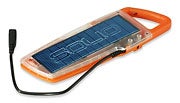
Environmentally Friendly Universal Charger: Solio Hybrid 1000

Solio's Hybrid 1000 lets you charge your phone (and other equipment such as music players and GPS devices) anywhere the sun is shining. It uses a solar panel to juice up its internal battery, which then charges your handset's battery. Depending on the energy needs of your device and the intensity of the sunlight, an hour of sunshine can provide enough power for up to 15 minutes of talk time or 40 minutes of music playback, according to Solio. The bundled adapters are compatible with certain BlackBerry, Motorola, and Nokia phones; with the iPhone; with a few types of GPS units; and with some MP3 players. If your phone isn't compatible with any of the included connectors (Palm Treos, for example, aren't supported), you'll have to buy a separate one (they cost $10 each).

$70, https://www.solio.com/

Solio's Hybrid 1000 uses solar energy to charge your cell phone's battery; it's convenient and environmentally friendly.

FireWire Could Hit 3.2 Gigabits Per Second

FireWire-based data transfer speeds seem set to quadruple, reaching 3.2 gigabits per second, according to the trade body that nurtures the standard.

The 1394 Trade Association last week announced its new S32 specification, which uses the existing cables and connectors already deployed for FireWire 800 products in order to make for a faster transition to the new speed. The specification is expected to be ratified by early February. {Read PCW's blog "Updated FireWire Specification to Challenge USB 3.0.")

Current FireWire 800 hard drives can easily move over 90 megabytes per second.

The S3200 specification brings FireWire to this new performance level without compromising existing features. For example, FireWire provides much more electrical power than any other interface, freeing users from inconvenient AC power adapters.

FireWire products built using S3200 will directly connect to every previously released FireWire product. Alternative cable options are available to carry FireWire over long distances - 100 meters or more - even at high speeds.

The best hard drives with FireWire 800 can move data almost three times as fast as the best hard drives with USB 2.0, claimed the standards body.

S3200 will also enhance FireWire's strong position in consumer electronics A/V devices such as camcorders and televisions. Today, 100 percent of HD set top boxes provided by cable companies have FireWire ports. So do 100 models of HDTV. Many companies are pursuing whole-home HD network solutions using FireWire - notably the HANA Alliance.

Technology development is also nearing completion to permit FireWire to operate over cable television coaxial cables, without disrupting the existing program content. S3200 lets FireWire move even uncompressed HD signals over long distances at much lower cost than systems such as HDMI.

"The S3200 standard will sustain the position of IEEE 1394 as the absolute performance leader in multi-purpose I/O ports for consumer applications in computer and CE devices," said James Snider, executive director, 1394 Trade Association. "There is a very clear migration path from 800 Megabits/second to 3.2 Gigabits/second, with no need for modifications to the standard and no requirement for new cables or connectors."

December 17, 2007

Ribbit unveils Web telephone development platform

By Sinead Carew

NEW YORK (Reuters) - Silicon Valley start-up Ribbit Corp on Monday unveiled a technology platform that will let developers put Web telephony in everything from business software to popular social network sites such as Facebook.

As well as planning to sell its own services directly to consumers in the first quarter, Ribbit said it is working with more than 600 outside developers who are using its technology to create their own voice applications.

Ribbit software serves as an interface between anything from Web sites, e-mail and instant messaging to mobile or regular phones. Developers do not need to be telephony experts to build services with Adobe's Flash software, which works on most computers.

"A developer can take telephony out of our sandbox and bring it to where you live," said Crick Waters, Ribbit's vice president for strategy and business development.

For example, he said that about four developers are using Ribbit to build services that consumers could incorporate into their personal pages on Facebook, a popular online hangout. These services could let members make and log calls and check their voicemail in transcript form without leaving Facebook.

Ribbit has already built an application that businesses will be able use within Salesforce.com Inc's customer relationship management software. This lets workers dial clients via the Internet from within the application and automatically stores a log of client calls and voicemail transcripts alongside the rest of that client's information.

About 30 corporations are testing the service, which will cost $25 a month per person and be available to Salesforce.com users in the first quarter. Ribbit did not disclose financial terms of its agreement with Salesforce.com.

For other applications that Ribbit is not directly involved in the third-party developer would also pay Ribbit a subscription based on the number of users of their service.

December 16, 2007

Indie filmmakers can score Moby freebies (Reuters)

Dance musician Moby has launched a Web site that gives his music away -- to the right people, of course.

He is licensing his music for free via mobygratis.com to help out indie and student filmmakers.

"I was a philosophy major and I had a minor in film," he says. "Ever since then, I've had a lot of friends in the world of independent and nonprofit film production. Their recurring complaint is that it's really difficult to license music for movies that have no budgets, so I thought I would start this Web site which very simply provides free music to nonprofit indie films."

The site offers 70 unreleased pieces of music. Moby says the music is "specifically designed" to be in films and would not be of interest to the general consumer. It also has been another creative outlet for him.

"I'm having fun and writing specific incidental pieces of music," he says. "I also have tons of music that I've made over the years that is more atmospheric or instrumental that would never find its way onto a record. So, selfishly, it's a way for me to find a home for music that otherwise would never get listened to."

Moby's double-platinum 1999 release "Play" is known as one of the most licensed albums ever. In hindsight, he admits to over-licensing.

"I probably should have been a little smarter in restricting some of the licenses," he says. "A lot of the people who criticized me for over-licensing 'Play' are now working in the licensing divisions of record companies. I think, if anything, I was a victim of doing too much too soon. Now everybody in the music business is desperate to license music.

"As record sales dwindle, the record labels will license anything and everything," he adds. "You have to make the right choices."

Moby will release his next album, "Last Night" (Mute/EMI), on March 11.

Reuters/Hollywood Reporter

ITRI debuts 10.4-inch color flexible display

aiwan's Industrial Technology Research Institute (ITRI) recently debuted its latest flexible display technology, including a color 10.4-inch cholesteric LCD (Ch-LC) flexible display and a flexible LED backlighting unit (BLU).

Instead of using glass substrate, the 10.4-inch color flexible display features two plastic substrates and a thickness of less than 10mm, ITRI said. Its structure design is simple and is both thin and light, with a thickness reduced to 50% of that of traditional color Ch-LCD displays. The flexible 10.4-inch display has an NTSC color gamut of 57%, according to ITRI.

The research institute also debuted a flexible LED-based BLU and claimed it has been successfully used in a 7-inch color flexible active matrix (AM) LCD display.

In addition, ITRI demonstrated a monochrome Ch-LCD flexible display which is built on a plastic substrate and is based on roll-to-roll manufacturing. The width of the display is 3.5-inches and the length of the display can be produced in any size. The product is ideal for large-size public displays, the institute noted.


A digital come-on tricks a New Zealand man into exposing himself to the wrong address.

WELLINGTON (Reuters) - A New Zealand woman who sent a naked man to the wrong house on the promise of a good time has been charged with misusing a telephone, local media reported last week.

The 17-year-old woman sent the man an enticing text message offering him an early Christmas present in the shape of two friendly women and suggested he take off his clothes to save time, the Manawatu Standard reported.

The 31-year old man wasted no time in arriving at the house, and took off his clothes and threw them through the window before entering.

But it was the wrong house and the householder did not see the funny side. The police were called and the man arrested for being unlawfully on a property.

The woman, who sent the tempting but deliberately wayward message, was also tracked down and charged for misusing a phone.

Both the man and the woman escaped prosecution and were cautioned and put on good behavior bonds.

(Editing by Jerry Norton)

December 15, 2007

eBay Takes a $30 Million Hit Over Buy It Now Patent

A Federal Court judge has found that MercExchange LLC is due $30 million from eBay in compensation for a patent breach of MercExchange’s “Buy It Now” patent, a long standing feature available on eBay auctions.

The case started back in 2001, and in 2003 a jury found in favor of MercExchange. According to the Wall Street Journal, the case triggered a review by the U.S. Supreme Court over whether injunctions or damage awards are sufficient remedies in patent cases, with a ruling in 2006 that “all but required injunctions in patent cases.” eBay convinced the court in September that damages alone would suffice in this case given the ruling, leading to the $30 million today.

MercExchange has said they will appeal the denial of its request for an injunction, but welcomed the $30 million in damages. eBay also plans to appeal the ruling.

Nokia N95 update speeds apps with virtual memory

The update, version 20.0.015, focuses on "battery, stability and performance improvements". Among them is the addition of "on-demand paging", essentially a way of parking blocks of memory to the handset's solid-state storage to make room for others - virtual memory, in other words.

The upshot, Nokia said, is that users can load more applications and switch between them more quickly than they could before.

Users will also be able to re-arrange the S60's menu layouts courtesy of the New Menu Structure app that comes with the update.

The update's battery tweaks make for longer gaps between re-charges, with the Finnish phone giant quoting an extra 30 per cent music playback duration post-update. That takes the N95's continuous music play time from nine hours to 12.

The software also includes a new version of Nokia Maps, which builds on the previous update that added Assisted GPS - helping out the handset's GPS receiver using triangulation sent across the network - with even faster positioning.

Downloaders will also get three days' free navigation, suggesting this paid-for add-on service isn't quite as popular as Nokia might have hoped it would be.

LiPS Forum completes mobile Linux spec

A group looking to establish interoperability standards to make it easier to develop applications for Linux-based mobiles has released the first cut of its specs.

The Linux Phone Standards (LiPS) Forum announced completion of the LiPS Release 1.0 specifications on Monday. LiPS said the standards will allow industry to achieve "basic interoperability" for applications and services deployed on Linux-based phones.

Shared open standards and implementations described by the spec include the LiPS reference model, telephony, messaging, calendaring, presence, address book and voice call enablers APIs.

The LiPS Forum hopes its standards will foster the use of Linux on mobile devices. The consortium was established two years ago with founding members that included ARM, France Telecom, Telecom Italia, Huawei and PalmSource. The Forum has since aligned itself with the Open Mobile Alliance, a standards body working on open standards for the mobile phone industry as well as attracting new members including BT.

Interest in running Linux on mobile phones has increased more recently since Google's November announcement that its Android mobile platform will be based on the open source operating system. The LiPS Forum is critical of the approach taken by Google and its partners.

"In contrast to recent announcements from other bodies promoting Linux-based mobile software, LiPS' output targets interoperability through real open standards and specifications, not de facto acceptance of single platform implementation," the LiPS Forum said in a statement accompanying the release of its spec. "The principal advantage to real open standards comes from choice of implementation," it added

Beta users can access the OpenOffice.org suite using a Web browser

Interested in trying out the free OpenOffice.org 2.0 office suite without having to install it on your computer?

Now's your chance.

That option became possible this week when OpenOffice.org and online application vendor Ulteo launched a beta project that hosts OpenOffice.org 2.0 on Ulteo's Online Desktop infrastructure, giving users online access to the applications and up to 1GB of related data storage.

In an announcement, the two groups said the project will be open to 15,000 beta users who will be able to access the applications using a Web browser on Windows, Linux or Mac OS X.

Beta users will also have access to the project's instant collaboration features, which will allow participants to invite other users to join them online in working on a document together in real time. Users can send invitations to others via e-mail, allowing access to documents in either read-only or full edit mode through a clickable link in the message.

"Now everyone can use OpenOffice.org from any connected PC, anytime, anywhere," Florian Effenberger, marketing project co-lead of OpenOffice.org, said in a statement. "You even can work together on documents online and collaborate with others. This especially is an interesting option for trainers and workgroups."

"Ulteo is very proud to deliver OpenOffice.org to the community in a new, useful and exciting way: online and designed for collaboration," Thierry Koehrlen, CEO of Ulteo, said in a statement. "We expect that it will ... spread OpenOffice.org to even more users now that it is simpler than ever to try and use it in a couple of clicks."

Users can register for the beta program at Ulteo's Web site.

Microsoft's Xbox 360 game console can create a strong and strange signal that disrupts wireless LANs.

Microsoft's popular Xbox 360 game console can create a strong and strange signal on wireless LANs, according to IT staff at Morrisville State College.

It's not clear whether the signal disrupts the college's WLAN access points or students' wireless notebooks. There is some anecdotal evidence, however, that it at least affects other radios in the same 2.4GHz band.

Morrisville IT staff typically use Bluetooth headsets, which run in the 2.4GHz band, with their cell phones when they troubleshoot problems on the spacious campus. "We had problems syncing our headsets to our phone where this signal was strong," says Matt Barber, the college's network administrator. A phone user had to physically touch the headset to the cell phone to make the initial connection, he says.

There may be effects on the WLAN that the equipment itself, from Meru Networks, is circumventing, according to Barber. Part of Meru's WLAN architecture employs software that gives the access points more control over wireless-client transmission behavior than does the software of some of Meru's rivals. An access point near a radiating Xbox may be compensating for interference by in effect guiding a wireless laptop to send and receive when open spectrum is available, essentially dodging around the Xbox signal.

Working with Meru, the small IT staff is planning to test soon the effect of multiple Xbox consoles in a dorm with a large number of active notebook clients.

Network World has asked Microsoft to comment on the Xbox signal phenomenon, but the company was not able to reply before this story was posted. We'll update this report as soon Microsoft provides information.

The latest version of the Xbox, the Xbox 360 Elite, went on sale earlier this year with a 120G-byte hard disk and a high-definition video interface.

Morrisville is a small college in rural New York state, taking its name from a nearby town. In summer 2007, the college deployed a campuswide 802.11a/b/g WLAN based on equipment from Meru.. The plan was to replace those access points with Meru's new, two-radio devices that added support for Draft 2 of 802.11n, the IEEE standard that boosts throughput from 22M to 25Mbps to at least 150M to180Mbps. That replacement was just completed, creating the first large-scale deployment.

During the fall, Morrisville IT staff, working with Meru engineers and IBM, the network integrator, detected an unusual signal in the 2.4GHz band. "We wanted to look at the [radio frequency] environment in our dorms," Barber says. "We always thought we'd run into some strange stuff [there] in the 2.4 range."

The signal was discovered using Cognio Spectrum Expert, from Cognio (recently bought by Cisco). Spectrum Expert is RF-analysis software packaged with a WLAN adapter card that slots into any laptop PC. (See our April 2007 Clear Choice Test of four WLAN protocol analyzers.) Among other capabilities, Spectrum Expert identifies sources of radio energy in the 2.4GHz and 5GHz WLAN bands, and identifies the cause, such as a brand of access point or a microwave oven.

"The signal really stood out," Barber says. "In some places it was so strong we thought it might be affecting the air [that is, the radio environment] around it."

The Cognio software, however, was baffled by this new signal: "Unknown emitter" was the classification. The signal shows up in the Cognio display as a kind of green-blizzard effect, covering a large swath of the 2.4 band, Barber says. That means the signal "is jumping all over the spectrum band," he says. In contrast, a nearby Meru access point shows up in the same scan as a strong, stable yellow-red glow, almost like a sun. The green blizzard is shot through with red dashes, which show, Barber says, that the signal at moments nearly rivals the access point in strength.

The mystery signal baffled the IT staff and Meru until Barber had a brainstorm: He brought in his own Xbox 360 and plugged it in, and turned on the Cognio spectrum analyzer. Presto: The same signal appeared.

Google is developing an online publishing platform

Google is developing an online publishing platform where people can write entries on subjects they know, an idea that's close to Wikipedia's user-contributed encyclopedia but with key differences.

The project, which is in an invitation-only beta stage, lets users create clean-looking Web pages with their photo and write entries on, for example, insomnia. Those entries are called "knols" for "unit of knowledge," Google said.

Google wants the knols to develop into a deep repository of knowledge, covering topics such as geography, history and entertainment.

Google's project will have to catch up with Wikipedia, which includes more than 7 million articles in 200 languages. Anonymous users constantly update Wikipedia entries in an ever-growing online encyclopedia that's edited by a network of vetted editors.

"We believe that knowing who wrote what will significantly help users make better use of web content," wrote Udi Manber, vice president of engineering, on the official Google blog.

Google said anyone can write about any topic, and repetition of entries on the same subjects is beneficial. Google will provide the Web hosting space, as well as editing tools.

Contributors can choose whether to let Google place ads on the knols. Google said it will give the contributors a "substantial" portion of the revenue generated by those ads. While Wikipedia lacks ads, keyword advertising has underpinned Google's growth.

Entries can't be edited or revised by other people, in contrast to Wikipedia. However, other readers will be able to rank and review others' entries, which will then be interpreted by Google's search engine when displaying results.

The concept of peer-reviewed information is nothing new and is implemented in different ways on various Web sites. Yahoo, for example, has an "Answers" feature where users can ask questions, and the response is ranked on quality. Also, most blogs have forms where readers can comment on the author's entry.

December 14, 2007

Nokia Invests in Chips that Enable Payment by Waving

Users of a device equipped with a near-field communications (NFC) chip can wave the device near a reader to make a payment or other transaction. The chips can be used in credit cards or phones, which customers can use to pay for items in a store or debit an account to access public transportation, for example.

Nokia has other NFC initiatives as well. It is the majority owner in Venyon, a joint venture company with Giesecke & Devrient, which is developing a service that banks and mobile operators can use to securely manage transactions made by cell phones with NFC technology.

Late last year, Nokia also announced that it was part of a trial in New York City with Citigroup, MasterCard and Cingular Wireless that lets users pay for items in certain shops using their NFC-equipped phones.

Hacking S60 3rd edition firmware and exploring S60 with AllFiles!!!Hacking S60 3rd edition firmware - Unlimited permissions for untrusted midletsBy default, Nokia S60 3rd Edition phones install midlets mostly with "oneshot" or "session" permissions, which force user to accept permission everytime a network connection is made or file is opened. If you don't have signing key (which costs $$$), you cannot even modify these permissions, because the phone only allows "ask everytime" option for e.g. file write.So, here's the hacking alternative - proceed at your own risk. By replacing some strings, we ca

n give equals permissions to untrusted applications with the manufacturer signed applications.First, update your S60 phone normally using Software Update tool from Nokia. It downloads updates to your harddrive, storing binary images to C:\Documents and Settings\All Users\Application Data\Nokia\Nokia Service Layer\A\nsl_service_module_00001\www.dsut.online.n okia.com.oti.caresuite\Products\Directory contents look interesting and for my phone there is about 50 MB rom image there. Simple strings scan on rom image shows contents some fragments of text based java permission file, which by closer look very interesting (at around 0x2310000 in my case) :Now, all you need to do is to open up your favourite hex editor and write "MaximumMode: Blanket" to permissions you want to allow, and if you feel risky you can change the DefaultMode as well. Now re-run the software update, force re-runing and phone will be flashed with your new permissions. After installing midlet, you should see more permission options in the application manager (select midlet, click open)...---
Exploring S60 with AllFiles

Symbian Signed says they won't accept any file explorer tools with AllFiles capabilities. As a result of firmware modification, they really don't need to do that, we can self-sign those!Here's couple of screenshots of Y-Browser running with AllFiles capability:By default, Y-Browser comes with standard set of capabilities, so we need to add AllFiles capability to the set. You'll need the fabulous sisinfo tool to unpack the sisx, elftran (from sdk) to modify executable headers and of course makesis and signsis to create new sisx.Extract .sisx contents:Finally, run makesis, signsis - you know the drill for selfsigning. For makesis you need .pkg file, Source: symbaali.info


December 11, 2007

Japanese Vendor Crafts Cell Phone for Kids

NTT DoCoMo is launching a new cell phone for children that has a loud "panic" alarm and a location-tracker to help parents find their kids quickly if they get lost.

The F801i is due to go on sale in Japan later this month and will be NTT DoCoMo's second handset for children. The first was launched in 2006 and has sold just under 500,000 units, according to Takeshi Natsuno, senior vice president and managing director of NTT DoCoMo's Multimedia Services division।

New to the F801i is a remote controller that children can wear on their wrist like a watch. The cell phone will lock if it is separated from the controller by more than a certain distance, if the child has forgotten it somewhere, for example. It will also ring when it gets within 10 meters of the controller, to help find it again. The phone will also notify the parents via email if it is separated from the controller for more than 5 minutes.

The F801i blocks access to adult Web sites, and can be programmed to block access to the Internet altogether between 10pm and 6am. At other times the phone shows a special children's version of the I-mode home page.

Like the first version, the new phone requires a screwdriver to remove the battery, to prevent children from removing it to disable the phone's tracking ability.

The WCDMA (wideband code division multiple access) handset measures 4.2 inches by 2 inches by 0.7 inches and weighs 4.2 ounces. It has a stand-by time of about 400 hours, talk-time of 185 minutes and video call time of 110 minutes. The phone is manufactured by Fujitsu, and there are no current plans to offer it outside Japan.

December 8, 2007

Music Downloads From Nokia

Nokia will launch a new service next year that allows people who buy certain Nokia phones to download music for free for a year after they purchase the device.

The company has signed a worldwide deal with Universal Music to offer the service and is in talks with other major labels, said Olli-Pekka Kallasvuo, Nokia's president and CEO, in a speech at the Nokia World conference in Amsterdam on Tuesday.

The service, called Comes with Music, will allow people to download as many songs as they want during the year after they buy the phone, and then keep the music after the year is up, Kallasvuo said.

He was joined by Lucian Grainge, chairman and CEO of Universal Music, who called the deal "a groundbreaking moment" for Universal. "There is no comparable service where music can be kept by the consumers even if their subscription lapses," he said.

The music industry has been criticized for complaining about illegal downloads while not doing enough to let people download music legally. Grainge said the deal with Nokia shows that Universal is "doing all we can to transform ourselves into a consumer-led business."

The companies would not discuss detailed financial terms of the offer. "It's called Comes with Music and I think that is fairly explanatory," Kallasvuo said. "You buy the [phone] and you have rights for one year of unlimited downloads."

Nokia spokesman Kari Tuutti said the service will be offered initially with Nokia's high-end Nseries devices, but eventually will come to a broader range of Nokia handsets. People will be able to download the music to both their phone and their PC, he said.

The cost of the service will essentially absorbed in the initial purchase price of the phone, but Nokia isn't saying yet if consumers will be charged a premium for phones that come with the service. Nokia will pay a portion of the revenue from the phones to Universal, Tuutti said.

"The music industry is making money on this and we hope to make money from this also," Kallasvuo said.

The service combines the world's biggest phone maker with the world's biggest music label. It will put Nokia more squarely into competition with Apple, which operates its iTunes service, and Microsoft, which has its Zune music player and online store.

Nokia Internet Services

The idea is to offer a single location where people can manage the content, services and contacts they accumulate when surfing the Internet on their phones and PCs, said Anssi Vanjoki, general manager of Nokia's multimedia group, at the company's Nokia World conference in Amsterdam.

Ovi.com will offer a single sign-on for the services, so people don't have to remember numerous log-ins and passwords on the Web, Vanjoki said. Nokia is also developing Ovi desktop software for organizing content offline.

Nokia began talking about Ovi in August, and one part of the service, an updated version of Nokia's mobile gaming platform, N-Gage Arena, is going live this month, Vanjoki said. The service worked in the past only with Nokia's N-Gage mobile game consoles, but the company said it will soon work with other devices too.

The games service is only the start. Nokia has said that an online music store will follow, and on Tuesday it provided more details of other services it will offer. They include mapping services, a video store and a photo service that allows users to upload photos from a phone and link them to maps, much as Google allows with its Picasa service today.

"Ovi will enable people to access social networks, communities and content. It's the foundation from which we'll expand Nokia in new directions," said Olli-Pekka Kallasvuo, Nokia's president and CEO.

Nokia holds more than a third of the world's mobile phone market, and it hopes that Internet-enabled devices like its N95 will become the primary way people access the Web in future। At a time when the average price of cell phones is falling, online services could help it build new business.

Ovi.com is being tested internally and will be rolled out for public beta next year, when the desktop software will also be released, Vanjoki said. The company demonstrated the software, which has snazzy interface elements, like a tool for organizing videos, photos and other files that makes them appear to be floating in three-dimensional space.

The service is likely to include an online storage component to make it easier to share files online. "We haven't yet announced the media-sharing service, but that will be part of the Ovi.com sales offering," said Nokia spokesman Kari Tuutti.

Access to Ovi.com and the desktop software will be free, Tuutti said. The software will be delivered on a CD with Nokia phones and offered for download over the Web.